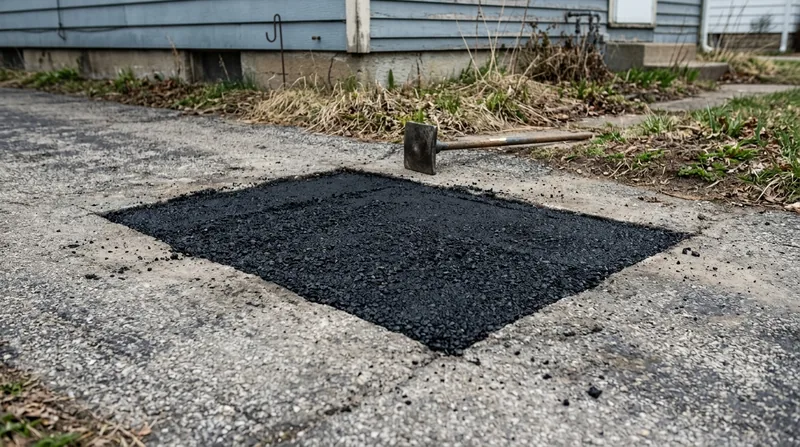




Davenport driveways face a relentless cycle of freeze-thaw damage that starts every winter and accelerates every spring. The city's steep bluff-side neighborhoods, from the Gold Coast down to Hamburg and Cork Hill, hold 1850s and 1900s Italianates and Queen Annes on narrow lots with short, pitched drives that channel water toward the street. Post-war ranches and worker cottages across central and West Davenport carry single-car ribbons now decades past their surface life, while the 1970s and 2000s subdivision stock in Bettendorf, Eldridge, and north Davenport adds wide driveways aging out together. Deep loess soil over heavy glacial clay holds water after 38 inches of annual rain, and dozens of freeze-thaw cycles pop potholes, heave aprons, and crack edges every winter. Road salt and snowplow gouges chew the pavement from December through March. Driveway repair in Davenport means stopping the damage before it reaches the base, or deciding honestly whether repair buys you years or whether the money belongs in resurfacing instead. We tell you which one it is.
Why Driveway Repair Matters in Davenport: The Freeze-Thaw Reality
Davenport sits in the heart of the Midwest freeze-thaw belt. Every winter, water seeps into tiny cracks in the asphalt, freezes solid, expands, and heaves the pavement upward. When it thaws, gaps open. Snow plows scrape and gouge the edges. By spring, sunken aprons, crumbling edges, and sections heaved over saturated clay are the norm. A single pothole or a failed edge patch left untreated grows into a base failure that costs thousands to fix. Catching damage early with a full-depth repair that keys into sound asphalt around it stops the spread and buys you years. Waiting for spring to become summer means the damage compounds, and a simple patch becomes a resurfacing job.
- Sunken aprons at the street edge allow water to pool and undermine the base below the asphalt.
- Crumbling edges from snowplow damage and salt exposure spread inward if not repaired with full-depth patches that tie into sound material.
- Heaved sections over wet clay create trip hazards and accelerate cracking in adjacent pavement.
- Spring potholes that appear overnight are the symptom of a base failure already weeks or months in the making.
The difference between a repair that holds and money wasted on a patch that fails by next spring is the depth and the bond to sound asphalt around it. Skin patches peel. Full-depth patches hold.
Local reality: A homeowner in McClellan Heights or East Davenport with a 1920s bungalow and a sloped drive sees water run toward the garage. A ranch in Park View or Bettendorf with a flat ribbon drive sits in standing water after every rain. Both need repair, but the pitch and the soil underneath change the repair strategy. Aprons and edges matter most on sloped drives; full-width heave matters most on flat drives over clay.
For more on what happens when repair isn't enough, see our page on asphalt resurfacing and overlay, where the full-surface answer lives.
Davenport's municipal code and your HOA rules (if you live in a master-planned community like Park View or Vander Veer Park) may require permits for driveway work, especially if you're extending an apron or cutting a curb. Check with the Davenport Building Department or your HOA before you call. We help homeowners navigate local permitting, but the jurisdiction sets the rules, and they vary from Davenport proper to Bettendorf to Eldridge to LeClaire.
How We Repair Driveways in Davenport: The Full-Depth Approach
A driveway repair starts with a hard look at what's failed and why. We measure the damage, probe the edges, and check the base. If the failure is isolated to an edge, an apron, or a section heaved over clay, a full-depth patch removes the failed material, prepares the base below, and installs new asphalt that bonds to the sound material around it. If the damage spreads across thirty or forty percent of the surface as alligator cracking and potholes, the base is gone, and patching throws money away. We tell you that too.
- We measure the damage area and probe the base to confirm the repair depth needed, typically four to six inches for a full-depth patch.
- We saw-cut clean edges around the failed section so the new asphalt keys into sound material and won't peel.
- We remove all failed asphalt and loose base material, then proof-roll the subgrade to confirm it's solid.
- We tack the edges with a bonding agent so the new asphalt welds to the old, not just sits on top.
- We install new hot mix asphalt compacted to the same thickness and grade as the surrounding drive, typically two to three inches on top of a prepared base.
- We finish the repair flush with the surrounding pavement so water sheds properly and plows don't catch an edge.
The result is a repair that holds because it's tied into sound asphalt, not a skin patch that fails by spring.
Example: A Davenport homeowner on a Hamburg bluff-side street has a sunken apron where water pools and runs under the drive. We remove the failed section, check the base, install a full-depth patch four inches deep, and compact it level with the street edge. The repair costs less than a full resurfacing and buys five to seven years because the bond is sound. If the same homeowner's entire drive shows alligator cracking, we recommend resurfacing instead, because patching multiple areas wastes money.
Repair Methods and When Each One Works
| Repair Method | Description | Best For |
|---|---|---|
| Full-Depth Patch | Remove failed asphalt and base, prepare subgrade, install new asphalt four to six inches deep, tack edges to bond with surrounding pavement. | Isolated edge damage, sunken aprons, pothole repair, heaved sections over clay where the base is sound around the failure. |
| Pothole Repair | Full-depth removal of failed material and base, proof-roll the subgrade, install compacted hot mix asphalt with proper bonding and finish flush with surrounding drive. | Spring potholes and localized base failures that have not spread to adjacent pavement. |
| Edge Repair | Saw-cut and remove crumbling or salt-damaged edges, prepare the base along the perimeter, install new asphalt edge that bonds to the drive and sheds water toward the street. | Snowplow damage, salt deterioration, and crumbling edges on bluff-side drives in Davenport where plows run hard December through March. |
| Apron Repair | Full-depth repair of the driveway apron where it meets the street, with careful attention to slope so water sheds away from the drive and the street. | Sunken aprons on steep bluff-side drives and flat aprons in central Davenport where water pools and undercuts the joint between drive and street. |
| Extensive Patching Assessment | Evaluate the entire drive for alligator cracking, multiple potholes, and widespread base failure to determine if patching is cost-effective or if resurfacing or replacement is the better answer. | Drives with damage covering thirty to forty percent or more of the surface, or where multiple patches would be needed within the next two years. |
Each repair method is chosen based on what failed, why, and how much of the drive is involved. A single pothole gets a full-depth patch. A crumbling edge gets an edge repair. A sunken apron gets an apron repair. If you're looking at five or six repairs over the next couple of years, resurfacing is the smarter money.
Driveway Repair Cost in Davenport: What to Expect
Driveway repair pricing in Davenport depends on the size of the failed area, the depth of the repair, the condition of the base, and how much cleanup and haul-away is needed. A single pothole or edge repair runs less than a full apron replacement. A drive with multiple repairs across different areas costs more than one concentrated patch. The best way to know is to get a written estimate with tonnage and depth specified, not a guess over the phone.
Several factors move the cost up or down. A repair on a flat drive over clay that requires base work costs more than a repair on a sloped drive where the base is already solid. A repair on a narrow bluff-side drive in Hamburg or Cork Hill where access is tight costs more than a repair on a wide suburban drive in Park View or Bettendorf. A drive that needs multiple repairs costs more per square foot than a single concentrated patch, because we have to move equipment and set up multiple times. Travel is included in our pricing across Davenport and surrounding areas, with no separate mileage fee.
The reason to get two or three estimates is not to find the lowest price, but to make sure you understand what the repair includes. A real estimate names the tonnage of asphalt, the depth of the repair, whether base work is included, and what the finished surface will look like. A price without those details is not an estimate, it's a guess. See our pricing page for starting figures and what moves them, then call (563) 200-7510 for a free, no-obligation estimate with full detail.
Driveway Repair Near Me: What to Look for When Hiring a Paving Contractor in Davenport
The history of driveway paving fraud in America is door-to-door crews with out-of-state plates and a story about leftover asphalt from a job nearby. They take a large cash deposit, do thin work, and disappear. A local contractor with a Davenport address and local plates is the first trust signal. We've been in business since 2011, we're fully insured, and we carry written estimates with tonnage and depth on every job.
When you're comparing contractors, look for these things. First, ask for a written estimate that names the repair depth, the tonnage of asphalt, and the scope of base work. If a contractor won't put it in writing, walk away. Second, ask whether they'll handle local permitting or help you navigate it. Davenport, Bettendorf, Eldridge, LeClaire, and other jurisdictions have different rules for apron cuts and curb work, and your HOA may have architectural standards. A contractor who knows the local rules saves you headaches. Third, call the Davenport Building Department or your HOA before you hire anyone to make sure you understand what permits you need. Fourth, ask for references from recent work in Davenport or the surrounding area, and call them. Fifth, verify that the contractor is fully insured and ask for a certificate of insurance. Sixth, never pay the full amount upfront. A reasonable deposit is one-third to one-half of the estimate, with the balance due when the work is done and you've inspected it.
If you're ready to get started, contact us for a free estimate. We'll measure the damage, walk you through the repair options, and give you a number with full detail. No obligation, response within 24 hours.
Driveway Repair in Davenport: Pricing Guide
| Service | Price | Details |
|---|---|---|
| Single pothole or edge repair | Starting at $450 | Full-depth removal, base prep, new asphalt compacted flush, includes material and labor for isolated failures up to 50 square feet |
| Sunken apron or corner repair | Starting at $650 | Full-depth apron replacement with proper slope and bonding, includes base work, material, and labor for typical bluff-side or flat drive aprons |
| Crumbling edge repair (per linear foot) | Starting at $75 | Edge removal, base prep, new asphalt edge bonded to drive, minimum 20 linear feet, typical cost rises with extent of salt damage and snowplow gouging |
| Multiple repairs or extensive damage assessment | On estimate | Drives with three or more separate failures or alligator cracking across thirty percent or more require on-site evaluation to determine if repair or resurfacing is cost-effective |
| Travel and site visit | Included | No separate mileage fee or call-out charge in Davenport, Bettendorf, Eldridge, LeClaire, Walcott, Muscatine, Clinton, and surrounding service areas |
| Estimate | Free | Written estimate with tonnage and depth specifications, response within 24 hours at (563) 200-7510, no obligation to book |
Indicative pricing, the exact cost depends on square footage, finish, and site access. Free personalized estimate within 24h at (563) 200-7510.


