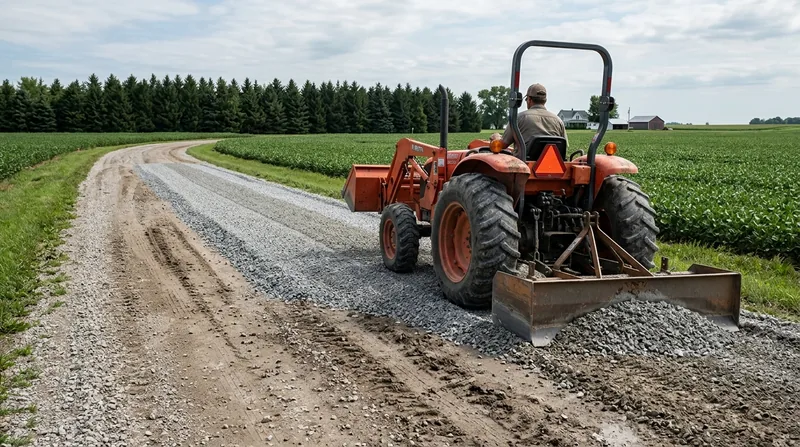




The flat farmland and rolling bluffs around Davenport sit on deep loess soil over heavy glacial clay that holds water after 38 inches of annual rain. Freeze-thaw cycles every winter pop potholes in gravel lanes; spring runoff cuts ruts through farm drives and HOA roads; and the 2019 Mississippi flood showed how fast water can undercut low-lying surfaces. A properly graded gravel driveway installation and grading job starts with the right base, good crown, and proper drainage so that the next rain runs off instead of pooling. Whether you own a long farm lane in rural Scott County, a subdivision drive in Bettendorf or Eldridge, or an older bluff-side property in McClellan Heights, the foundation you build now is the foundation every future paving project will sit on. We install new gravel drives in proper lifts of crushed limestone road stone over fabric, and we regrade and crown existing lanes to shed water and fill the potholes that spring rain carved out. Good grading is also the first step of every asphalt paving job, and we build the base once and correctly over this clay.
Why Gravel Driveway Installation and Grading Matters in Davenport and Scott County
Davenport's terrain ranges from steep brick Italianates and Queen Annes on narrow Gold Coast lots above the Mississippi to sprawling 1970s-2000s subdivisions in Bettendorf and Eldridge with wide driveways that are aging out together. Beyond the city, the flat farmland of Scott, Clinton, and Muscatine counties carries long gravel farm lanes and machine sheds where drainage is survival. The problem is the soil: deep wind-blown loess over heavy glacial till clay that compacts hard but does not drain. Without proper grading and crown, water pools in ruts and potholes, frost heave cracks edges in winter, and the base deteriorates year after year. A gravel driveway that sheds water stays firm and lasts; one that collects it becomes a washboard of ruts and a mud pit after rain.
- We install new gravel drives in proper lifts of crushed limestone road stone over landscape fabric to separate stone from subgrade clay.
- We regrade and crown existing lanes so water runs to the shoulder instead of pooling in the center or along the edges.
- We fill potholes and washboard ruts that spring runoff carved into lanes, and we do it right so they do not come back next year.
- We build the base correctly the first time, because every future asphalt paving job will sit on the grade you establish today.
A well-graded gravel drive also signals to the county, to your HOA, and to potential buyers that the property is maintained and drained properly.
Key info: Spring is the worst season for gravel drives in Davenport. Freeze-thaw cycles pop potholes in March and April, and runoff from melting snow and April rain carves ruts through lanes. We handle emergency regrading and pothole fill from April through June, and we schedule new installations in May through September when the ground is dry enough to compact properly.
For more context on how grading fits into larger paving decisions, see our guide to asphalt driveway paving and installation.
How We Install and Grade Gravel Driveways in Davenport: Step by Step
A new gravel driveway starts with site inspection and measurement to understand the slope, the subgrade, and the drainage pattern. We use a laser level to check crown and identify low spots where water will pool. We then remove old degraded material if needed, prepare the subgrade by proof rolling to compact the clay, and lay landscape fabric to keep the new stone from mixing into the soil. We then install crushed limestone road stone in proper lifts, compacting each layer so it binds and does not rut under traffic. For regrading existing lanes, we crown the center and fill potholes with new stone, then proof roll to firm it up. The result is a drive that sheds water, resists washboard, and gives you a solid base if you decide to pave in asphalt later.
- We measure the driveway, check the existing grade with a laser level, and identify drainage problems and low spots.
- We remove old failed material and proof roll the subgrade to compact the clay and create a firm bearing surface.
- We install landscape fabric over the prepared base to prevent stone from mixing into the clay and to extend the life of the gravel.
- We place crushed limestone road stone in lifts, compacting each layer with a vibratory compactor so it binds and resists rutting.
- We establish proper crown so water runs to the shoulders, and we taper the edges so water does not pond along the perimeter.
- We proof roll the finished surface to confirm compaction and to identify any soft spots that need additional stone.
A properly installed gravel drive will stay firm and drain well for five to seven years before it needs re-stoning, depending on traffic and climate.
Local example: A 200-foot farm lane in rural Muscatine County with standing water in the center and deep ruts along the shoulder took two days to regrade. We removed the old degraded material, crowned the center, installed new crushed limestone in two lifts, and compacted it. The drive now sheds water, the ruts are gone, and the farmer can use it year-round. The same drive is now ready for asphalt paving whenever the owner decides to upgrade.
For information on how grading and base preparation support driveway replacement, see our full service overview.
Gravel Driveway Installation and Grading Methods: What Works Best
| Approach | Description | Best for |
|---|---|---|
| New gravel installation | Subgrade preparation, landscape fabric, crushed limestone in lifts, compaction, and crown establishment. | New drives, extensions, or complete replacement of failed gravel. |
| Regrading and crown restoration | Laser-level inspection, removal of degraded material, subgrade compaction, and new stone placement with proper slope. | Existing drives with washboard, ruts, or poor drainage; preparation for future asphalt paving. |
| Pothole filling and spot repair | Removal of failed material in localized areas, compaction of subgrade, and placement of new stone with proof rolling. | Emergency spring repairs; lanes with isolated soft spots or frost heave damage. |
| Gravel with recycled asphalt millings | Mix of crushed limestone and recycled asphalt in a single lift or as a top layer, compacted to a firm surface. | Budget-conscious owners; rural lanes; temporary upgrade before future asphalt paving. |
Gravel Driveway Installation and Grading Cost in Davenport: What to Expect
Gravel driveway installation and grading in Davenport typically starts at $950 for a small regrading and pothole fill job on an existing lane. Larger new installations, longer farm lanes, and drives that need extensive subgrade work cost more and are quoted on site after we measure and inspect the property. The main factors that affect price are the length and width of the drive, the current condition of the subgrade, whether we need to remove old failed material, and the distance we need to haul stone. A 150-foot residential driveway with good subgrade and straightforward grading runs less than a 400-foot farm lane with poor drainage and deep ruts. We provide written estimates and tonnage specifications so you know exactly what you are getting and what it costs.
We recommend getting two or three estimates from different contractors so you can compare price, approach, and how much stone and compaction each one specifies. A cheap estimate that skips the landscape fabric or does not compact each lift properly will fail within a year or two. A good estimate names the tonnage of stone, the number of lifts, and the compaction method. See our full pricing page for more detail on how we structure quotes and what to expect when you call for an estimate.
Key info: Do not confuse cheap gravel spreading with proper grading. A contractor who dumps stone and does not compact it or establish crown is not building a driveway that will last. Good grading requires a laser level, a vibratory compactor, and experience reading the subgrade. That is why we charge for it and why it matters.
Gravel Driveway Installation and Grading Near Me: What Davenport Homeowners Should Know When Hiring
Hiring the right contractor for gravel driveway installation and grading in Davenport starts with verifying that the company is fully insured and has a local address and local plates. The historic fraud in driveway work is the itinerant door-to-door crew with out-of-state plates who claims to have leftover material from a nearby job and offers a price that is too good to refuse. A legitimate local contractor will give you a written estimate, name the tonnage and compaction method, answer your questions about drainage and base preparation, and provide references from local jobs. Ask about their experience with Davenport's clay soil and freeze-thaw cycles, because not all contractors understand how to build a base that holds up in our climate.
If your property is in an HOA or a master-planned community, check the architectural standards before you hire, because some HOAs restrict driveway materials or require approval for extensions or regrading. If your drive borders a public right-of-way or involves a culvert or apron, your municipality may require a permit. Davenport, Bettendorf, Eldridge, and other Quad Cities communities have different rules, so verify with your local building department before work starts. If you are grading near a property line, call Iowa 811 to have utilities located before you excavate, because hitting a gas line or a fiber optic cable is a serious and expensive mistake.
- Get a written estimate from any contractor you hire, and make sure it names the tonnage of stone, the number of lifts, and the compaction method.
- Ask for references from recent jobs in Davenport, Bettendorf, Eldridge, or nearby communities so you can verify the contractor's work.
- Confirm that the contractor is fully insured and carries liability coverage in case of property damage or injury during the work.
- Check your local municipal rules on driveway permits, apron requirements, and drainage standards before you hire.
- Verify HOA rules if your property is in a master-planned community, because architectural standards may restrict materials or require approval.
- Call Iowa 811 before any excavation, because the law requires utility location and marking to prevent damage to buried lines.
When you are ready to get started, contact us for a free estimate. We will inspect your property, measure the drive, and give you a written quote with tonnage and compaction details so you know exactly what you are getting.
Gravel Driveway Installation & Grading in Davenport: Pricing Guide
| Service | Price | Details |
|---|---|---|
| Pothole fill and spot repair | Starting at $950 | Emergency regrading and stone placement on isolated ruts or washboard; price varies with location and access |
| Regrading and crown restoration on existing drive | Starting at $1,200 | Laser-level inspection, subgrade compaction, new stone in lifts, and crown establishment; price scales with length and width |
| New gravel driveway installation | Starting at $2,100 | Subgrade prep, landscape fabric, crushed limestone in proper lifts, compaction, and crown; depends on drive size and soil condition |
| Farm lane or long private road regrading | On estimate | Extensive regrading, multiple lifts of stone, and drainage work on properties over 300 feet require site inspection and measurement |
| Travel and equipment | Included | No separate charge for travel within Davenport and surrounding service areas; equipment and labor are included in the estimate |
| Free estimate | No obligation | Call (563) 200-7510 for a free on-site estimate; response within 24 hours; we provide written quote with tonnage and method |
Indicative pricing, the exact cost depends on square footage, finish, and site access. Free personalized estimate within 24h at (563) 200-7510.


